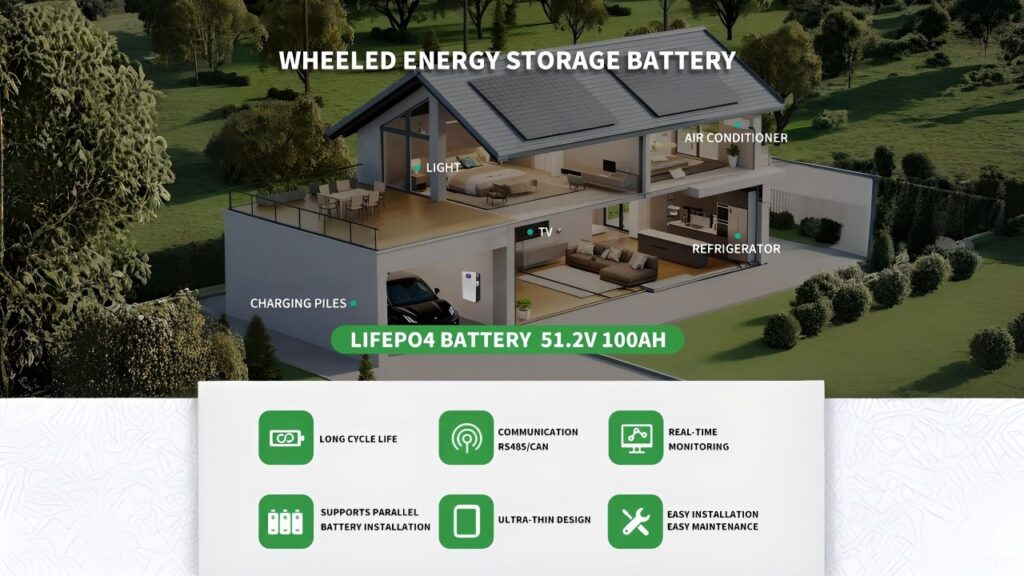
Low voltage energy storage system refers to an energy storage system operating within a relatively safe voltage range. Common voltage ranges are 12-48 volts and 43.2-57.6 volts. Their voltage does not change with battery capacity. For example, MOREDAY’s WALL-MOUNTED HOME ENERGY STORAGE can increase battery capacity by continuing to connect batteries in parallel while maintaining the voltage at 48/51.2 volts. It is ideal for small systems and is mainly used in residences, RVs, and ships.
This article will analyze whether a low voltage energy storage system is suitable for your project by examining its performance parameters, main application scenarios, and advantages and disadvantages.
Table of Contents
ToggleWhat is a low voltage energy storage system?
A low voltage energy storage system typically refers to an energy storage device used in a residential setting. Its main components include:
Battery Module:
Taking the wall-mounted home energy storage mentioned in the introduction as an example, it consists of 16 3.2V Class A LiFePO4(lithium iron phosphate) cells connected in series (3.2V × 16 = 51.2V). Cell types are available in 100Ah, 200Ah, and 280Ah, and this is the most important part of the entire low voltage energy storage system.
Battery Management System (BMS):
This is usually integrated directly into the battery as a motherboard. Independent BMS systems are relatively rare in low voltage energy storage systems. Its main functions include battery balancing, overcharge and over-discharge protection, temperature protection, short-circuit protection, SOC/SOH monitoring, and communication with external systems. For more details, please refer to the previous article “What is Battery Management System (BMS)?“.
Inverter:
Responsible for converting the direct current (DC) from the energy storage battery into alternating current (AC) for home use.
Protection devices:
These typically include circuit breakers, fuses, disconnect switches, and reverse connection protection to ensure stable operation of the energy storage system.
Communication interfaces:
Common interfaces include RS485/CAN/Modbus, used for information exchange with mainstream inverters.
Chassis/Enclosure:
Household enclosures are mostly wall-mounted or stand-alone, or equipped with casters and insulation panels, and must also support good heat dissipation for internal components.
Connecting cables:
Dedicated battery cables, grounding wires, and inverter cables (if photovoltaic cables are available) are used to connect or communicate with all the above components.
How does it work?
The operation of a low voltage energy storage system consists of four steps: charging, energy storage, discharging, and management and protection. The core of the entire process is the battery module and the Battery Management System (BMS).
- Charging: Through the MPPT (Multi-Level Photovoltaic Power Supply) (the core function of the photovoltaic inverter), unequal voltages are converted into stable and suitable current and voltage before being connected to the battery.
- Energy Storage: In standby mode, the BMS continuously monitors the battery’s health and status.
- Discharging: The inverter converts the battery into AC power suitable for household use. Simultaneously, the BMS monitors the entire process and automatically cuts off power in case of dangerous situations such as overcurrent or overheating.
- Management and Protection: The entire process is managed by the BMS, which has a complete grasp of the status of each battery cell and outputs data through the communication system.
Why do people choose low voltage energy storage systems?
The advantages of low voltage energy storage systems are obvious in the relevant scenarios:
- Safety: Low voltage energy storage systems are generally below 60V. In the unfortunate event of a short circuit, the energy of the arc is relatively small, and fire is less likely. The BMS monitors various indicators of the battery modules in real time and automatically disconnects the battery output when an anomaly is detected.
- Simple installation: Low voltage energy storage systems are generally complete finished products. They only require connecting cables to other equipment and debugging via the operating interface to operate normally.
- High cost-effectiveness: The entire low voltage energy storage system does not require a specific high-voltage control box, and personnel do not need high-voltage qualifications, insulated clothing, or other supporting tools. Your main expense is only the low voltage energy storage battery itself.
Application
- Areas with unstable power supply or no grid connection.
- Areas where photovoltaic systems are installed but only generate electricity during the day and cannot be used at night.
- To reduce electricity costs, low voltage energy storage systems are used to power homes during peak electricity consumption periods and to recharge the systems during off-peak periods.
Installation and Maintenance
The installation process for low voltage energy storage systems is simple, but a key point is to choose a well-ventilated location to avoid heat buildup and moisture. It has its own internal control system; a comprehensive check once a year is sufficient, without the need for daily monitoring.
What to Consider When Purchasing
Calculate your household’s typical electricity usage? How long do you plan to use the system without relying on the grid (charging and discharging between 20% and 90% can appropriately extend the lifespan of the low voltage energy storage system)? Brand stability is important; MOREDAY uses Grade A battery cells, and their low voltage energy storage systems come with a 5-year warranty.
Conclusion
Low voltage energy storage systems, also known as home energy storage systems, are used to store electricity to prevent power outages due to unstable power supply or excessive electricity costs during peak hours.
MOREDAY also manufactures such systems. If you need selection advice, please feel free to contact us.